Compare Gambling And Insurance
- Compare Gambling And Insurance Costs
- Compare Gambling And Insurance Rates
- Compare Gambling And Insurance Mcq
In my early years in the insurance field, it was quite difficult to convince myself, let alone others, that insurance is not the same as gambling. In those days, any attempt to convince someone on the need to buy insurance was almost always met with resistance and a concluding remark that, “No, I can’t buy your insurance. I don’t like gambling.”
As I progressed in the profession, it gradually became clearer to me that insurance is distinct from gambling. But the fact remains that many people out there still remain difficult to convince. They hold strongly to the view that insurance is gambling and, for many of these people, they would never have anything to do with any of the two.
From the surface, insurance and gambling look alike: they have to do with risks, they are both contracts, and payment is made from a pool of fund in both cases. Insurance and gambling fall within the aleatory category of contracts. By definition, aleatory contracts are those “contracts in which the performance of one or both parties is contingent on a particular event.” They are both contingent on “something happening.”
Insurance is not Gambling (Explained) Insurance and gambling were considered alike because there is an uncertainty of events and payment is made when the event occurs. Like gambling, the insured is unaware of the time and amount of loss. If the event occurs, the insured like the gambler gains; otherwise, they are experiencing the loss. Financial benefits. PENN NATIONAL GAMING offers first-class financial benefits for employees and their family members. A first-class 401(k) plan makes sure that employees have a secure retirement, while a generous, fully paid parental leave allows expecting mothers and fathers to enjoy their child's first year.

For gambling, you take a bet and if you win, you get paid. But if you lose, the other party profits by pocketing your money or whatever you bet with. For insurance, you get paid if the insured event occurs. If you are lucky (or, is it unlucky as some people claim?) that you do not suffer any loss; the insurance company keeps your premium so you get nothing from them. When one looks at insurance from this perspective, it becomes quite easy to conclude that insurance is the twin sister of gambling.
I must accept the fact that this was actually the way people perceived insurance at its early stage of development. The first life insurance law which was enacted in Great Britain in 1774 was aptly titled Gambling Act 1774 (or Life Assurance Act 1774). It illegalized gambling with people’s life. Prior to the advent of this law, it was possible for David to insure the life of Charles with a view to profiting from the death of Charles, whether or not there was any financial interest or relationship between the two of them. In other words, before the passing of the Life Assurance Act (Gambling Act) on 20th April, 1774, one could take out a life insurance policy on anybody’s life (including a criminal) with the expectation that the person insured would die before a specified date. If death occurred as expected, profit would be made by the one who arranged the insurance as he would receive a payment. The law stopped all this form of gambling practices.
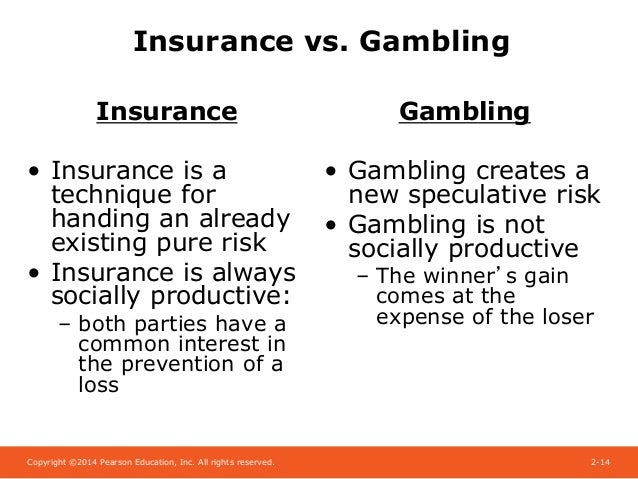
One of the easiest ways of differentiating between insurance and gambling in this modern days is to look at what gamblers and those who buy insurance do. A gambler pays to take an unnecessary risk. He creates a risk for himself and he knows full well that he would either win (and make profit) or lose (and bear the risk of losing his money). On the other hand, someone who buys insurance is actually paying the insurance company to avoid the consequences of risks that are necessary. The risks are already there for him, duly identified, and he is paying to avoid or minimize the negative financial effects those risks could have on him. Such risks being insured against are essential for human development and they include, among many others, the risk of accident while travelling in a car, the risk of fire while manufacturing goods in a factory, and the risk of falling and dying while constructing a 25-storey building.
Compare Gambling And Insurance Costs
Gambling belongs to the class of risks known as “speculative risks.” These speculative risks present one with the probability of making a profit or losing. There is no in-between. You either lose or win. Insurance, on the other side of the coin, belongs to the “pure risk” classification of risk where one either suffers a loss or remains in the same position (i.e. neutral). One does not profit from a pure risk exposure. If you insure your car for a year and no loss is recorded, you simply continue to ‘cruise’ your car around (i.e. neutral).
Compare Gambling And Insurance Rates
If the above still confuses you, I think you can just distinguish between insurance and gambling by looking at your insurance premium as the price you pay to buy yourself peace of mind from identified risks. Once you pay the premium to the insurance company, you buy peace of mind because of the promise you receive from the insurance company that payment would be made if you suffer a loss. You don’t buy such peace of mind when you put down your money in a bet. In fact, when you put your money down in gambling you actually buy yourself some worries and apprehension. You are scared that you may lose and say goodbye to your money forever. But if you win, luck is probably on your side. Unlike insurance, nobody promises you that payment would be made if you lose in a gambling attempt.

Facebook Comments
Insurance – How Is It Different From Gambling?
Anyone for blackjack? How about a few spins on the roulette wheel? Or how about a bet on your favorite sports team for this weekend’s game? Gambling in moderation, of course, can be a fun pastime which gets the juices flowing and enables banter with friends and colleagues.
How is insurance different from gambling?
Think about it. You promise to pay someone (usually an insurance company) some cash (a ‘premium’, payable in installments) related to some ‘event’ which may or may not occur in the future. If that event occurs, you suffer a loss and the insurance company compensates you for that loss. If the event doesn’t occur, the insurance company keeps your cash.
How is this different from placing a bet on the name of a newborn member of the royal family? Or next week’s weather? The difference is that, when buying insurance, there must be the risk of some ‘loss’ – what lawyers call an ‘insurable interest’. That loss can have serious consequences and is something you seriously want to avoid. (No, the heartbreak of seeing your local team lose does not constitute a ‘loss’ for these purposes!)
Your business faces a whole host of risks which can have devastating effects. Understanding and managing those risks is important but achieving the right balance is the goal and can be tricky. Some businesses neglect to buy insurance with catastrophic consequences and others are ‘over-insured’ resulting in waste.
Tips for managing your insurances
You may want to take advice on your approach to insurance and here are some quick tips:
1. Think broadly about your risks: Could your customers experience harm? Or the general public? Or your directors or shareholders? Or your employees or vendors? What about your facilities or assets? You may need insurance as a matter of statutory compliance or because it is required by contract or constitution. You should thoroughly review your needs.
2. Get expert advice: No two businesses have identical insurance needs. Insurance contracts can be complex, and an expert can ensure you are properly protected. Choose your expert wisely since they tend to specialize by industry or by the kind of coverage. A phone conference or appointment with us could be a first step to make sure you are on the right track.
3. Shopping around: There are usually many providers of similar insurance policies, often competing on price. Always consider a selection before deciding and get more than one quote.
4. It’s not only about price: For complex policies, especially in business, there may be specific items you want to insure against. Be diligent about reviewing the entire contract and pay attention to different charges, types and levels of cover, ‘cooling off’ periods and how excesses are calculated.
5. Already have insurance? You can drive prices down by taking a cheaper quote to your existing provider. They may be willing to beat or match your quote immediately or when you need to renew.
6. Consider different ways to buy: You may have an insurance broker or financial advisor who should be proactive in assessing your needs and coverage. Banks might offer this service and there are numerous comparison sites which help you evaluate online insurers. Each channel has advantages and disadvantages, but it is usually best to work with someone who really understands your business and goals.
7. Answer the insurer’s questions accurately: Sounds obvious, but many claims are unsuccessful due to errors or a lack of proper documentation.
Ready to consider your insurance coverage? The starting point is to assess your business goals and the main risks you should protect against. Bressler & Company is uniquely positioned to support you and then ensure you access the right coverage from the best possible providers.
By all means, have an occasional bet when the opportunity arises – but don’t leave your business future to chance!
Compare Gambling And Insurance Mcq
Call us at 559.924.1225. We’d be happy to help you review your insurance needs and make recommendations for improvement, or take the survey below and we will contact you with the results.